
The modern landscape of talent acquisition is defined by a simple, brutal reality: scale. For every open position, especially in highly competitive fields like technology or healthcare, a recruiter is often tasked with sifting through hundreds, if not thousands, of applications. This deluge of data, resumes, CVs, cover letters, and a variety of file formats creates a bottleneck that traditional recruitment methods are simply not equipped to handle. The result is a process that is slow, expensive, and, most critically, prone to human error and unconscious bias, often leading to qualified candidates being overlooked.
The solution isn’t hiring more recruiters — it’s building smarter systems. Today’s talent leaders are turning to next-gen AI Resume Parsing Services that go far beyond keyword matching, interpreting context, skills, and intent with near-human precision. This shift is quietly reshaping how organizations identify talent, streamline hiring journeys, and scale without burning out their teams.
As companies push for sharper, leaner, and more intelligent operations, these AI-driven capabilities are becoming the natural backbone of modern recruitment. You’ll see this evolution reflected across broader AI Solutions for Businesses, where smarter workflows and cleaner decision-making are setting the new standard for growth.
The Broken Promise of Traditional Sifting
Before the rise of sophisticated AI, recruitment was often reliant on two methods: manual screening and first-generation keyword parsers. Understanding the limitations of these old systems underscores the urgent need to adopt intelligent algorithms.
The Cost of Manual Screening
Human recruiters are unparalleled in assessing cultural fit, communication skills, and nuanced qualitative aspects of a candidate. However, when faced with the high-volume, repetitive task of initial resume review, their efficiency plummets. Recruiter fatigue sets in quickly, leading to what is known as ‘skim-reading.’ During this phase, a human reviewer spends mere seconds on each document, scanning for familiar job titles, company names, or educational institutions. This highly subjective and time-constrained process is the single most significant entry point for human bias, where decisions are often unconsciously influenced by non-job-related factors such as a name, address, or a university’s perceived prestige.
The cumulative effect of manual screening is devastating:
- Time-to-Hire Inflation: Weeks are lost just in the initial application review stage.
- High Opportunity Cost: Recruiters are bogged down in administrative tasks instead of engaging with qualified leads.
- Inconsistent Quality: The quality of the shortlist depends heavily on the individual recruiter’s focus and energy level at that moment.
The Flaws in First-Generation Parsers
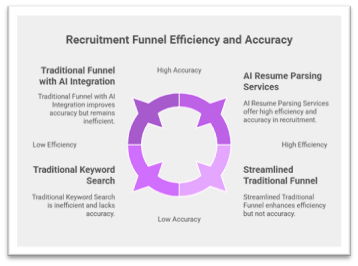
To combat the manual bottleneck, early Applicant Tracking Systems (ATS) introduced basic parsing tools. These tools were essentially glorified data extractors, designed to lift text from a document and plug it into structured database fields. While this helped with data organization, their matching logic was simplistic, relying heavily on exact-match keywords.
Consider a job requiring expertise in “Customer Relationship Management software.” A candidate who listed “CRM tools,” “Salesforce proficiency,” or “Client Management solutions” would often be filtered out because the algorithm only searched for the exact phrase “Customer Relationship Management software.” This system was prone to generating a high rate of false negatives, where qualified talent was sometimes mistakenly discarded simply because they used slightly different terminology. These rigid, brittle systems provided only the illusion of efficiency, sacrificing candidate quality for marginal gains in data structure.
The Mechanics of Intelligent Parsing: Moving from Keywords to Context
Next-generation AI Resume Parsing Services operate on a completely different premise than their predecessors. They utilize advanced machine learning (ML) and Natural Language Processing (NLP) to interpret a candidate document the way a seasoned recruiter does—by understanding context, semantics, and relationships between data points.
Natural Language Processing (NLP) at Work
The heart of advanced parsing is NLP. Unlike older systems that just read text, modern NLP engines understand it. The algorithm can determine that “Managed a team of 15 developers” is a quantifiable leadership experience, not just a collection of words. It identifies the relationship between the role (“Managed”), the quantity (“15”), and the subject (“developers”), and maps this complex concept to a structured data field for “Team Management.” This semantic understanding is critical for accuracy.
The best systems, capable of accurate automated CV parsing, also handle ambiguity and document variability with ease:
- Handling Diverse Formats: Whether the input is a PDF, Word document, a custom-formatted CV, or even a scanned image, the parser uses intelligent layout analysis and Optical Character Recognition (OCR) to convert the document into usable, structured data without losing information fidelity.
- Interpreting Synonyms and Intent: The system knows that “Java,” “J2EE,” and “JVM-based development” are related concepts and can correctly score them against a requirement for “Backend Development Experience.” This ensures that candidates are not penalized for using industry-standard but non-exact phrasing.
The Deep Learning Advantage
The accuracy of an intelligent parser stems from its ability to learn through deep neural networks continuously. By training on millions of anonymized candidate profiles —both successful and unsuccessful —across numerous industries, these systems develop a nuanced understanding of what constitutes a “good fit” beyond explicit keywords. This enables the algorithms to:
- Extract Skills from Context: A traditional parser might miss “Python” if it’s only mentioned in a project description. A deep learning model recognizes the skill by analyzing the context of the surrounding verbs and nouns in the description.
- Standardize Varied Data: It automatically standardizes job titles (“Software Eng,” “Sftw. Developer,” “Engineer”) into a standard taxonomy (“Software Developer”), making comparisons across a diverse pool of applications consistent and accurate.
This level of detail in automated CV parsing not only saves countless hours of manual data entry but also lays the perfect foundation for the next stage: intelligent matching.
From Parsing to Precision: AI Candidate Matching
The true power of AI in recruitment is realized when parsing transitions into sophisticated matching, transforming raw resume data into rich, standardized inputs. AI Candidate Matching Solutions then perform complex candidate-to-job mapping by delivering a semantic, multi-dimensional score based on three critical factors:
- Skills-to-Job Fit: Scoring the depth of skills against job requirements.
- Experience-to-Role Fit: Analyzing tenure and industry alignment.
- Potential-to-Growth Fit: Assessing transferable skills for long-term value.
Automating this analysis replaces days of manual sifting with minutes of data analysis, providing a significant edge. McKinsey & Company research shows that organizations leveraging this AI can reduce their time-to-hire by up to 40%. This accuracy and speed define truly scalable recruitment AI solutions, maintaining consistent quality whether hiring for one role or 10,000, which is essential for growing enterprises.
Mitigating Bias and Building Trust
One of the most profound impacts of intelligent algorithms is their role in addressing the pervasive problem of unconscious bias in hiring. Since AI systems are objective and data-driven, they can eliminate the subjective human filters that historically excluded diverse talent.
Ethical AI and Objective Scoring
One of the most profound impacts of intelligent algorithms is addressing unconscious bias. Since AI systems are objective and data-driven, they eliminate the subjective human filters that historically excluded diverse talent.
Eximius is built on Ethical AI, trained to focus exclusively on merit-based data: skills, validated experience, and competencies. It actively ignores protected characteristics (age, gender, ethnicity, etc.) that can influence human judgment.
Fairness is achieved through:
- Skills-First Evaluation: Candidates are scored purely on job requirements, not prestige or personal identifiers.
- Data Transparency: An “explainable” scorecard shows why a candidate was matched, allowing recruiters to audit the decision and reducing the ‘black box’ problem.
Despite these advances, trust is vital. A Gartner survey found that only 26% of job candidates trust that AI will fairly evaluate them. This underscores the need for proactive transparency. By demonstrating that the technology is designed for fairness, not just speed, companies build the trust needed to attract top talent.
After the AI Resume Parsing Services extract the initial data, the system moves to validated screening. Most platforms for Screening and Assessments utilize conversational AI bots to evaluate candidates more naturally — assessing fit, intent, soft skills, and role alignment through real-time, human-like interactions.
From Automation to True End-to-End Intelligence
The integration of sophisticated parsing and precision matching is the catalyst for genuine end-to-end hiring automation. The value of AI lies in unifying the entire workflow into a single, intelligent pipeline, moving beyond isolated task completion.
When every administrative step, from job posting creation to initial shortlisting, is automated, the role of the human recruiter is radically redefined. Recruiters are no longer data processors; they become strategic relationship builders.
- Focus on Strategy: Recruiters spend less time sifting and more time interviewing, negotiating, and strategizing on talent attraction.
- Enhanced Candidate Experience: Automation ensures every applicant receives a prompt, professional, and personalized response. The use of AI Candidate Matching Solutions enables deeper personalized outreach, resulting in higher response rates.
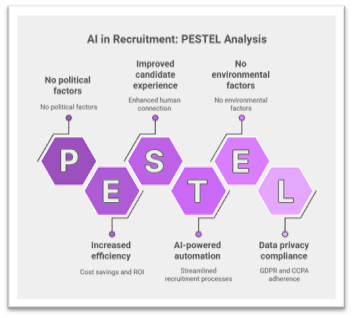
This strategic shift provides massive organizational benefits. A report by Deloitte found that 72% of employees feel that automation frees up their time to focus on more meaningful tasks. When applied to recruiters, this leads to increased job satisfaction, greater productivity, and a better bottom line.
To maximize these gains, platforms must offer truly scalable recruitment AI solutions that adapt to changing business needs. Your system must handle sudden spikes in hiring demand without any drop in shortlist quality. This robustness, achieved through constant algorithmic refinement and a unified platform, ensures that the integration of automated CV parsing with advanced matching enables recruitment teams to deliver high-quality, ready-to-interview candidates faster than ever before consistently. The future of talent acquisition is here, powered by intelligent algorithms.
The Final Word: Your Strategic Competitive Advantage
The era of sifting through thousands of resumes is over. By embracing AI Candidate Matching Solutions, you move beyond slow, expensive, and error-prone processes. You gain precision, speed, and objective fairness.
Intelligent algorithms liberate your recruiters from the arduous task of data input, allowing them to focus entirely on human connection and strategic engagement. The result is a better, more accurate, and more diverse hire, transforming talent acquisition into an undeniable source of competitive advantage.
Stop getting stuck in the sifting stage. Start building interview-ready shortlists in minutes.
Ready to Transform Your Hiring?
Claim Your AI Co-Pilot: Start Shortlisting Candidates Today! Sign Up for Free.


